
ExPolaris by ExLatticeLPBF thermal simulation
See where heat
builds up.
Before you print.
Fast, scan-path-aware thermal simulation for metal laser powder bed fusion (LPBF). Move from quick screening to detailed full-build analysis before committing machine time and material.
Top view & Y–Z cross-sectionCalculated output using an assumed IN625 material profile.
Simulation description
This simulation shows heat spreading and cooling as the laser scans five consecutive layers. The left view looks down on the part; the right shows a vertical cross-section through its internal features. Brighter colors indicate warmer regions. Both views advance together.
Compare process options
Prioritize physical testing
How it works
From build data to thermal histories.
Bring the planned manufacturing inputs. Explore the calculated response.

Provide your build inputs
Supply supported toolpaths, part layout, laser settings, material properties, and preheat or boundary conditions.
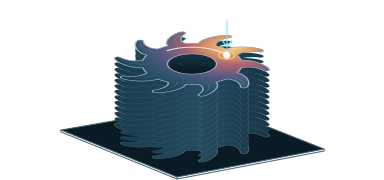
Simulate with ExPolaris
Model how the laser's energy input and scan sequence shape temperature throughout the build.
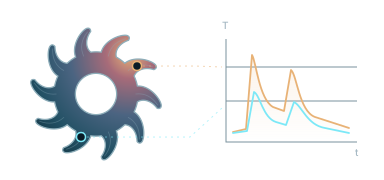
Review the thermal results
Inspect temperature histories by region and layer, and compare the response to different build settings.
Conceptual workflow illustrations.
Engineering use cases
Start with the decision on your desk.
Choose a practical question for build preparation, process development, or software integration.
Discuss your use caseWhich regions need closer attention?
Review fins, overhangs, and neighboring parts for elevated thermal exposure.
Build preparationWhich power and speed settings suit our toolpath?
Evaluate candidate settings against the temperature response you want to achieve.
Early optimization prototype. Iterates on simulation and thermal histories to help refine laser power and scan speed.
Seeking early testers
Discuss early testing
Privacy notice
Which strategy should we test on the machine?
Compare scan order and part placement to shortlist candidates for an experiment.
Process developmentCan we connect ExPolaris to our software?
Discuss toolpath import, repeated runs, and result exchange for your platform.
Machine & software teamsResearch support & startup programs



One North Carolina Small Business Program · SBIR matching grant recipient
Compatibility & possibilities
Thermal insight for your build.
Support for your build
Systems: EOS and other LPBF systems.
Materials: SS316L, Ti64, IN625, IN718, and AlSi10Mg.
Toolpaths: CLI, CLI+, and other formats.
Support for more machines, materials, and toolpath formats is on the way.
Broader applications of ExPolaris thermal results
When combined with established models and validation for your application, thermal results can help investigate porosity, residual stress, distortion, and microstructure, and contribute evidence to part qualification.
Discuss your applicationCommon technical questions
Before we start.
What should we bring to a technical demo?
Your machine, material, build configuration, and thermal question are enough to begin. We can then confirm suitable input formats and any data needed for an evaluation.
Will it work with our machine and material?
We support EOS and other LPBF systems, with a growing range of materials and toolpath formats. Share your machine model, material, and file format so we can confirm the right setup for your build.
How long will our simulation take?
Choose a coarser resolution for quick screening or a finer resolution for detailed analysis. Runtime varies with build size, resolution, and GPU hardware; we can walk through a representative case in your demo.
How can we become an early tester?
Contact us with your machine, material, and toolpath challenge. We'll discuss whether the optimization prototype suits your use case and agree on an evaluation scope. The optimization prototype's supported configurations and performance are still being evaluated.
Can it support our software or OEM workflow?
We can review toolpath access, batch evaluation, and data-exchange requirements. Available interfaces and deployment options must be confirmed for your platform.
Let's discuss your build
Bring your next LPBF question.
Share your machine, material, and what you want to compare. Build files can follow once we agree on the scope.
Machine & materialBuild or parameter questionDesired comparison
Request a technical demo
See ExPolaris in action.
We'll review your build question, demonstrate relevant thermal outputs, and discuss a focused evaluation.
Request a technical demoOpens an email draft with prompts to get started. Privacy notice
Or email directlyinfo@exlattice.com
Please do not email confidential build files. Contact us to agree on secure transfer and any required confidentiality terms.